
1-855-957-8378
Benefab®
Cart 0
  • Home
  • Shop

    Horse Products 16

    People Products 8

    Dog Products 5

    Bundles 5

  • Press
  • Blog
  • Pre-Loved
  • Dealers
  • Wishlist
  • Account
My Account
Log in Register
Australia (AUD $)
Belgium (EUR €)
Canada (CAD $)
Costa Rica (CRC ₡)
Czechia (CZK Kč)
France (EUR €)
Germany (EUR €)
Italy (EUR €)
Japan (JPY ¥)
New Zealand (NZD $)
United Kingdom (GBP £)
United States (USD $)
English
Benefab®
  • Shop

    Horse Products 16

    People Products 8

    Dog Products 5

    Bundles 5

  • Press
  • Blog
  • Pre-Loved
  • Dealers
Account Wishlist Cart 0

Search our store

Benefab®
Account Wishlist Cart 0
Home / Blog
Blog

How Horses See the World: 10 Things to Know

Sep 23, 2021
How Horses See the World: 10 Things to Know

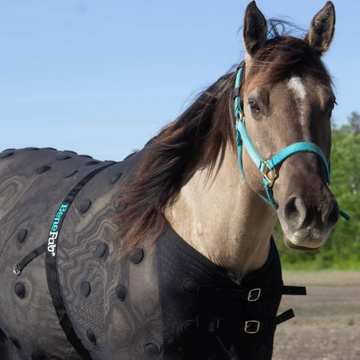
As riders, it's effortless to assume that everything sees the world as we do. From the dogs and cats at the barn to our very own horses, the colorful and often clear world we see is not the same world animals see. Here are ten things to keep in mind when working with horses.

Horses have limited color vision

A horse's vision is often compared to the vision of a red/green colorblind person. This means apples will look very similar, and the colors they see the most are shades of yellow and blue. Keep this in mind when selecting colors for things you want to be highly visible to horses.

Horses' depth perception is different from people

For context, a human's 20/20 vision means we can see details at 20 feet. Horse's vision, on the other hand, is said to be 20/30. This means that the details humans can see at 30 feet, a horse would need to be at 20 feet to see. This discrepancy is part of why horses' depth perception is not the same as people's, at least until a horse gets closer to an object.


Horses see well at night

Horses see better than people at night. This is because their rectangular pupil and tapetum lucidum – an internal structure – reflects light and allows decent sight in dim settings.

Horses struggle with quick lighting changes

Horses may be able to see better at night, but they take longer to adjust to changes in lighting. While people's eyes can quickly adjust, horses need up to 20 minutes to fully adjust to dim barn aisles and dark trailers. So be patient with your horse when heading into a new barn or arena with a lighting change.

Horses have a built-in shade structure in their eyes

If you've ever looked closely at a horse's eye, you've likely seen the granulae iridica, a small, wavy and protruding shade structure in the horses' eye. This helps them in bright scenarios, and it's speculated that it assists in-depth perception.

Horses see moving objects better than stationary ones

Understandably, as prey animals, horses see moving objects better than stationary ones. If you see a pony in a field 50 yards away that hasn't moved, prepare for your horse to notice the pony when it starts moving if they don't smell it first.

Horses will raise their heads to focus on objects

A horse raising its head gives an opportunity for their binocular vision (vision using both eyes for things in front of them) to be put to use. If a horses' head is tucked and behind the vertical, their binocular sight is reduced to the dirt in front of them. A horse raising its head gives them better sight and improved depth perception.

Horses experience eye irritation, just like people

Horses can experience eye irritation and blindness from external factors and genetic diseases. Flies and uveitis, also called moon blindness, can cause eye irritation and weeping.

Horses are prey animals, and their eyes are placed laterally on their heads

This means something coming from their side is actually the center of their vision since they have predominantly monocular vision (meaning their eyes work independently).

Horses see nearly 360 degrees, with a few exceptions

Thanks to their eye placement, horses see 90% of what's around them. They have blind spots directly behind them and very close in front of them, although a slight turn of the head alleviates the blind spots.

Previous
Service Dog Awareness Month
Next
Living Holistically: Improving Mental and Physical Health

Related Articles

Feeding a Show Heifer
December 03, 2025

Feeding a Show Heifer

Raising a competitive show heifer takes more than just good genetics and steady training. Feeding...
Read more
Natural Remedies for Canine UTIs
November 21, 2025

Natural Remedies for Canine UTIs

If your dog suddenly needs more walks, has accidents in the house, or seems uncomfortable...
Read more
What is a Cold Back Horse?
November 06, 2025

What is a Cold Back Horse?

A cold back horse often shows discomfort when pressure is applied to its back, particularly...
Read more
The Benefits of Bentonite Clay for Dogs
October 22, 2025

The Benefits of Bentonite Clay for Dogs

We all want our dogs to be happy and healthy, so it makes sense to...
Read more

Recent Posts

Feeding a Show Heifer
Natural Remedies for Canine UTIs
What is a Cold Back Horse?
The Benefits of Bentonite Clay for Dogs
Spine Problems in Dogs
Feeding a Show Steer
Can You Ride a Horse That Has Cellulitis Safely?
Cushing’s Disease Dog Diet
Showing Cattle Equipment: Your Guide for Competition
Treating Your Dog’s Ear Infection at Home

Focused &
Durable Designs

Products made specifically for you and your pets.

Free U.S. Shippingon All Orders over $200

We have you covered.

We Back Our
Products 100%

It's our customer promise.

BRAND PARTNERS

  • Become a Dealer
  • Become an Affiliate
  • Become a Registered Nonprofit
  • Logins for Dealer
  • Logins for Affiliate
  • Affiliate Resources
  • Meet our Ambassadors

CUSTOMER SERVICE

  • Contact
  • Shipping
  • Privacy Policy
  • Terms of Service
  • Money Back Guarantee
  • Warranty & Return Policy
  • Medical / Brand Disclaimer
  • FAQs

ABOUT BENEFAB

  • Why Choose Benefab?
  • The Benefab Story
  • Parables Podcast
  • Our Sister Brands
  • Media Inquiries
  • Blog
© 2013 -2025 Benefab®. Property of the Naar Boven Corporation. All rights reserved.
Payment options:
  • American Express
  • Apple Pay
  • Bancontact
  • Diners Club
  • Discover
  • Google Pay
  • Mastercard
  • PayPal
  • Shop Pay
  • Visa

Confirm your age

Are you 18 years old or older?

Come back when you're older

Sorry, the content of this store can't be seen by a younger audience. Come back when you're older.