




When we think about a horse with back pain, most of us immediately think about a sore back, resistance under saddle, or a horse that doesn’t want to work. But, back pain can show itself in many different ways, and sometimes the signs have us looking everywhere except the horse’s spine.
Kissing spine is one of those conditions that can be easy to overlook. It can be associated with back soreness, mild or intermittent lameness, changes in carriage, difficulty bending, resistance to work, and in more severe cases, a horse that simply cannot perform the way we expect them to.
Kissing spine, technically known as overriding or impinging dorsal spinous processes (DSPs), occurs when the bony projections along the top of the horse’s vertebrae become too close together and, in some cases touch or overlap. When these areas become painful, the horse may change the way they stand, move, carry themselves, and use their back to find relief. A horse that is uncomfortable through the spine may not stand squarely. They may shift their weight, hollow their back, brace through their body, or continually look for a position that feels better. If a horse isn’t standing and moving evenly because they are trying to take pressure off their back, the way they load their feet can change. Over time, this may contribute to uneven hoof wear, changes in hoof balance, or problems such as quarter cracks.
A quarter crack does not automatically mean a horse has a kissing spine. There are many reasons a horse can develop a quarter crack. But when we see changes in the feet along with back soreness, it is worth taking a step back and looking at the whole horse.
What Can Contribute to Kissing Spine?
-
Predisposed Breeds. Research suggests Warmbloods, Thoroughbreds, and Quarter Horses may be at increased risk.
-
Conformation. The shape and structure of a horse’s back can influence the spacing and alignment of the dorsal spinous processes.
-
Genetic Component. Recent research has identified genomic regions associated with the severity of kissing spine, suggesting that genetics may play a role.
-
Training and Body Use. Proper conditioning, progressive strengthening, and correct movement are important pieces of developing a strong, balanced horse.
-
Hoof Balance. Changes in hoof balance, including a negative plantar angle in the hind feet, have been discussed in relation to back and movement problems. This is where proper veterinary and farrier evaluation is important.
So enough about what kissing spine is and where back soreness can come from. The better question is: What can we do to help our horses?
CORE STRENGTH
Our horses need a strong core to properly support their backs. They need to be able to lift through the back, engage the abdominal muscles, use the hindquarters underneath themselves, and carry their bodies in a balanced way. So, what exercises can we do to encourage the horse to lift their back, strengthen their core, bring the hind end underneath them, and improve their overall balance?
Think of yoga for horses….
When it comes to building core strength in our horses, think of it as a little bit of yoga for horses. We aren’t trying to simply make them work harder. We are teaching them to become more aware of their bodies, stretch and move more freely, build strength, and learn how to properly carry themselves.
This concept comes from Visconte Simon Cocozza’s “Core Correction” method, which was featured in The Equine Chronicle in an article titled “Core Strengthening Exercises… For Your Horses” and describes four important elements to developing core strength in our equine partners: Stretch, Trust, Strength, and Education. These four principles provide a great way to think about how we help our horses become stronger, more balanced, and more confident in their movement.
-
STRETCH: encourage the horse to lengthen through the muscles and spine, improving flexibility and range of motion while helping to release tension.
-
TRUST: build confidence and trust so the horse feels comfortable bending, stretching, and moving freely without feeling restricted.
-
STRENGTH: develop the core and supporting muscles that allow the horse to better stabilize their body and carry themselves.
-
EDUCATION: teach the horse how to properly move, bend, and engage their body while using aids to support and guide those movements.
Simple Exercises that Horse Owners Can Do
-
Carrot stretches. Use a carrot or treat to encourage the horse to bend their neck and body toward different positions—toward the girth, between the front legs, and toward the flank. This engages the abdominal muscles.
-
Belly Lifts. With the horse standing square, gently run your fingers or a firm object along the midline of the abdomen, encouraging the horse to lift their back. Encourages abdominal engagement and activation of the muscles supporting the spine.
-
Backing Up. Ask the horse to slowly and calmly back several steps, focusing on straightness rather than speed. This encourages engagement of the hindquarters and abdominal muscles while promoting body awareness.
-
Hill Work. Walking up gentle hills can be an excellent strengthening exercise when appropriate for the horse. It encourages the horse to engage in the hindquarters and core while lifting through the back.
-
Poles. Walking over ground poles, starting with one or two poles and gradually progressing, can encourage the horse to pick up their feet, flex their joints, and become more aware of where their body is.
-
Transitions. Simple transitions such as walk-halt, walk-trot, and trot-walk can encourage the horse to engage their hindquarters rather than simply falling onto the forehand.
Supporting the Back: Where Benefab® Fits In
How can we support our horses before, during, and after exercise?
At Benefab®, our goal has always been to help horses stay comfortable, mobile, and ready to do their jobs. Our products are designed to be part of a horse’s everyday routine – not to replace good horsemanship, proper conditioning, veterinary care, saddle fit, or a good farrier, but to work alongside them.
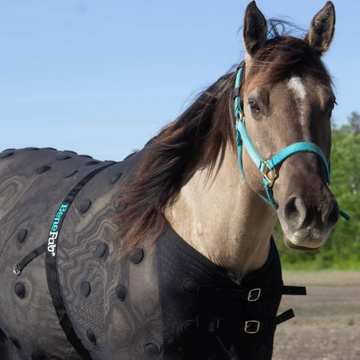
The Rejuvenate SmartScrim
The Benefab ® Rejuvenate SmartScrim combines far-infrared-emitting minerals with 84 individually pocketed, medical grade magnets rated at 1100-gauss strategically positioned over key areas of the body, including the vertebrae, hindgut, shoulders, haunches, and stifles. Learn more here >>>
It can be used before a ride as part of your preparation routine, during travel, after exercise as part of recovery, or simply while your horse is relaxing in the stall.
What Does the Research Say?
The Benefab® Rejuvenate SmartScrim has also been studied at North Dakota State University. In a 2017 study, 18 horses identified as having back pain wore either a magnetic/far-infrared sheet or a control sheet overnight. Researchers found that the horses wearing the therapy sheet showed higher pressure thresholds and concluded that they experienced reduced back pain compared with the control group.
What About the Saddle Pad?
Of course, once we put a saddle on the horse, we are asking the back to do even more. That makes saddle fit incredibly important. A therapeutic saddle pad cannot correct a poorly fitting saddle, but the right pad can be another piece of the puzzle when it comes to supporting the horse’s comfort under tack.
Benefab’s® therapeutic saddle pads use fabric infused with far-infrared-emitting minerals. The pads are designed to sit comfortably along the horses’ back while helping keep the back muscles supple and relaxed. They are breathable, moisture-wicking, and designed for use during exercise.
Benefab® offers different pads for different disciplines, including All Purpose, Dressage, and Western. Each is shaped with the horse’s back and withers in mind, while providing a layer of cushioning between the horse and the saddle. Learn more here >>>
We want our horses to be strong enough to carry themselves, flexible enough to move freely, educated enough to understand what we are asking, and comfortable enough to do the job we are asking them to do. The goal is to build a better routine for our horses, and to pay attention when they tell us something is wrong.


